

Software Developer Resume Writing Tips: ATS, Projects, and Keywords
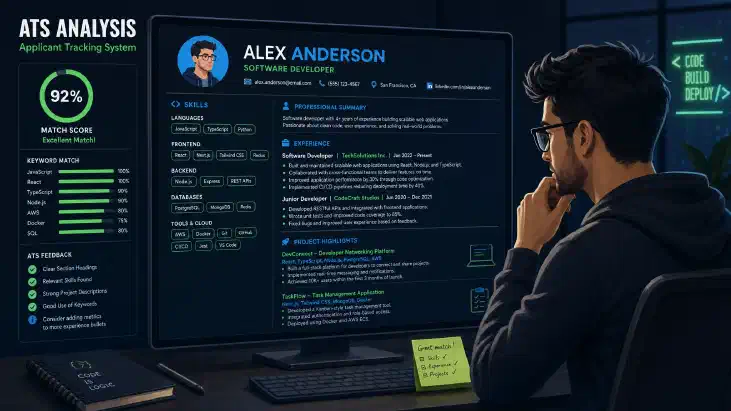
Table of Contents
Click Here to Return To the Software Development Career Playbook
A developer resume has one job: get you the phone screen. Hiring managers spend 15 to 30 seconds on a first pass using an Applicant Tracking System (ATS) that filters for keywords before a human reads the file. Your resume must survive both filters. The best developer resume is scannable, specific, and makes the reader’s next step obvious — contact this person.
For a complete deep-dive on resume writing with ATS strategy, section structure, and tailoring templates, see the Resume Optimization Course .
Resume Structure for Developers
Use this order for all developer resumes:
- Contact info — name, city/state, email, LinkedIn URL, GitHub URL, portfolio URL.
- Summary — two to three sentences: role target, primary skills, experience level.
- Skills — languages, frameworks, tools, and platforms organized by category.
- Experience — reverse chronological. For each role: title, company, dates, three to five bullet accomplishments.
- Projects — three to five portfolio projects with tech stack and measurable outcomes.
- Education — degree, school, graduation year. Certifications if no degree or if certification is more relevant.
- Certifications — (optional section if substantial).
For early-career candidates with no experience, move Projects above Experience.
Writing the Skills Section
List skills as a structured inventory, not a block of text. Group by category.
Languages:   Python, JavaScript, TypeScript, Go, SQL
Frameworks:  React, FastAPI, Node.js, Express
Databases:   PostgreSQL, MongoDB, Redis
Tools:       Docker, Kubernetes, Terraform, GitHub Actions, AWS
Do not pad the skills section with technologies you cannot discuss in an interview. If it is on your resume, expect to be asked about it.
Writing Experience Bullets
Every bullet should follow: Action verb + what you did + measurable result.
- Bad: “Worked on the backend API.”
- Good: “Redesigned authentication service using JWT and Redis session caching, reducing login latency by 60%.”
- Bad: “Helped improve the deployment process.”
- Good: “Built GitHub Actions CI/CD pipeline that automated testing and deployment, reducing release time from 3 hours to 12 minutes.”
Use strong technical action verbs: architected, implemented, optimized, automated, refactored, deployed, designed, migrated, integrated, reduced, scaled.
Writing the Projects Section
Projects are your proof of work. Format each one consistently:
Project Name | GitHub link | Live demo link
Tech stack: React, FastAPI, PostgreSQL, Docker, AWS
- Built a [what it does] for [who uses it]
- Key technical achievement (performance, scalability, novel approach)
- Usage data or outcome if available (X users, processed Y requests/sec)
For early-career developers, the projects section is the most important part of the resume. Three to four strong projects outperform years of vague work experience.
ATS Keyword Strategy
Most companies use ATS software that scans resumes for keyword matches before routing to a recruiter. To pass this filter:
- Pull exact technical terms from the job description and include them verbatim in your resume.
- Do not abbreviate or use synonyms if the job posting uses a specific term (the JD says “Node.js”, not “NodeJS”).
- Include the programming languages listed in the job posting in your skills section even if they are peripheral.
- Match both the tool names and the context (“AWS Lambda” not just “Lambda”).
Common Developer Resume Mistakes
- No GitHub link. A developer resume without a working GitHub profile is missing its most important supporting document.
- Objective statement. Replace with a summary that states your value, not what you want.
- Listing responsibilities instead of accomplishments. “Responsible for database maintenance” is worthless. “Optimized PostgreSQL query performance, reducing p99 latency from 800ms to 90ms” is a hire signal.
- One-size-fits-all resume. Tailor the summary and skills emphasis for each job application.
- Page length anxiety. One page is correct for under 5 years of experience. Two pages is fine for 5 to 10 years. Three pages is almost never correct.
- Font tricks. Tiny fonts, white text keywords, and multi-column layouts break ATS parsers. Use a clean, single-column format.
Next Steps
- Building a Developer Portfolio
- Software Developer Interview Preparation
- Software Development Career Playbook Home