

Is Software Development a Good Career in 2026? The AI Reality Check
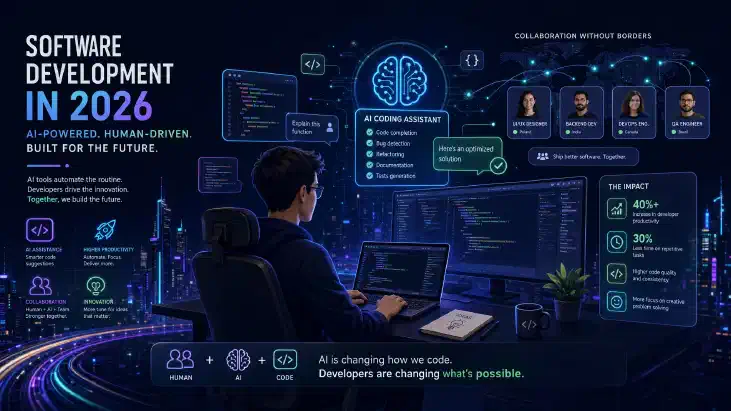
Table of Contents
Click Here to Return To the Software Development Career Playbook
Software development is still one of the strongest careers available in 2026. But the version of it that was easy to coast into is gone. AI coding assistants have accelerated senior productivity, made some junior tasks redundant, and raised the bar for what “entry-level qualified” means across every sub-discipline. The developers thriving in this environment are not the ones with the most certifications or the most impressive educational credentials. They are the ones who can prove they built something real, understand it deeply, and can explain every decision.
What AI Did to Software Development by Mid-2026
The impact is real and uneven across career levels:
At the entry level, the market is much harder. AI tools (GitHub Copilot, Cursor, Claude, ChatGPT) have made a senior developer significantly more productive. Companies that needed 3 junior developers for a feature now need 1 senior developer and AI tooling. Junior headcounts have contracted at large tech companies. The roles that remained are harder, require more independent judgment, and have 5 to 10 times the application volume they had in 2022.
Middle management in engineering is getting squeezed. When a senior engineer with AI tools does the work of three, you need fewer managers. Engineering manager headcounts at mid-to-large tech companies have been declining since 2023. The EM role is not gone, but it is under more scrutiny and harder to enter from an IC track without a strong track record.
At the senior and staff levels, the story is different. AI multiplies the output of experienced engineers. A senior developer who knows when to use AI assistance, how to review AI-generated code, and how to direct AI toward the right problems is significantly more valuable than one who does not. These roles are growing, not contracting.
Specialized roles are in high demand. Platform engineering, ML/AI infrastructure, security engineering, and embedded systems are areas where AI has created demand rather than reduced it.
The Differentiator That AI Cannot Fake: Proof of Work
By mid-2026, every developer applicant has an AI-assisted resume. A significant fraction have used AI to generate portfolio-sounding descriptions of work they did not fully understand. Hiring managers at most technical teams have adapted: they ask deeper technical questions, they review GitHub commit histories, and they are explicitly looking for evidence that the candidate understands their work at a level an AI could not generate for them.
What actually differentiates candidates now:
| Evidence | Why It Works |
|---|---|
| A deployed project with real users | Proves you shipped something end-to-end, handled real feedback, and maintained something under actual conditions |
| GitHub activity with real commit history | Shows the progression of your thinking. AI cannot fake a year of consistent, evolving commits to a growing codebase |
| An ability to explain architectural decisions in depth | “Why did you use PostgreSQL instead of MongoDB for this?” with a specific, considered answer means you understood the choice |
| Open source contributions to real projects | Proves you can navigate an unfamiliar codebase, communicate with experienced maintainers, and deliver to external standards |
| A public homelab or dev environment | For backend/DevOps/platform candidates especially: a documented self-hosted environment with infrastructure-as-code proves real production-adjacent skill |
A junior developer who cannot explain their portfolio projects at a deep technical level, under interviewer probing, will fail the interview. AI can write the code. AI cannot explain why you made the choices you made if you did not make them consciously.
The Honest Job Market in 2026
It is harder to break in, but better to stay in. Entry-level developer hiring volume at consumer tech companies is 30 to 50% lower than the 2021 peak. But enterprise software, healthcare software, defense software, industrial control systems, and government IT modernization are all actively hiring developers who can demonstrate working, maintainable software.
Roles that are growing:
- Platform and DevOps engineering — infrastructure automation is a force multiplier for AI tooling; demand is high.
- ML/AI infrastructure and MLOps — someone has to build the systems that run AI tools.
- Security engineering — AI creates attack surfaces and automates attacks; defense requires humans who understand both.
- Embedded and systems programming — hardware-adjacent code requires deep contextual understanding AI cannot reliably substitute.
- Full stack developers at companies using AI products — companies building AI-powered features need developers who can integrate LLM APIs and evaluate AI outputs.
Salary Reality in 2026
Senior compensation has grown. Junior compensation has compressed somewhat due to reduced headcounts and increased applicant-to-opening ratios.
| Role | Entry Level (2026) | Senior (2026) | Trend |
|---|---|---|---|
| Frontend Developer | $65K–$90K | $135K–$185K | Stable |
| Backend Developer | $70K–$95K | $145K–$200K | Growing |
| DevOps / Platform | $80K–$110K | $155K–$220K | Strong growth |
| ML Engineer | $90K–$130K | $185K–$270K | Strong growth |
| Security Engineer | $85K–$115K | $160K–$230K | Growing |
| Junior Developer (general) | $60K–$85K | N/A | Soft |
FAANG and top-tier tech companies continue to pay significantly above these ranges through equity. Use levels.fyi for company-specific data.
So Is Software Development Still Worth Pursuing?
Yes, with clear eyes about what the path looks like.
The developers who will build excellent careers from 2026 forward are the ones who:
- Build real things and document them publicly. Not tutorial clones. Original projects with genuine use cases, deployed and maintained.
- Develop AI proficiency as a core skill. Not as a crutch. As a productivity multiplier that augments their own judgment and domain understanding.
- Go deep on one specialization before claiming to be a generalist. The AI has already made shallow generalism cheap. Deep expertise is expensive to replicate.
- Maintain a portfolio that evolves continuously. A GitHub last updated in 2023 tells a hiring manager you stopped learning. An active repository with recent commits, evolving complexity, and documented decisions tells a different story.
- Can explain every line of their code in a technical interview. If you cannot defend a decision, you did not make it — and interviewers can tell.
The path is harder at the entry level than it was in 2020. The ceiling for seniors who embrace AI is higher than it has ever been.
Next Steps
- Building a Developer Portfolio
- Software Developer Salary and Job Outlook
- Software Development Career Playbook Home