

What Does a Software Developer Career Path Look Like?
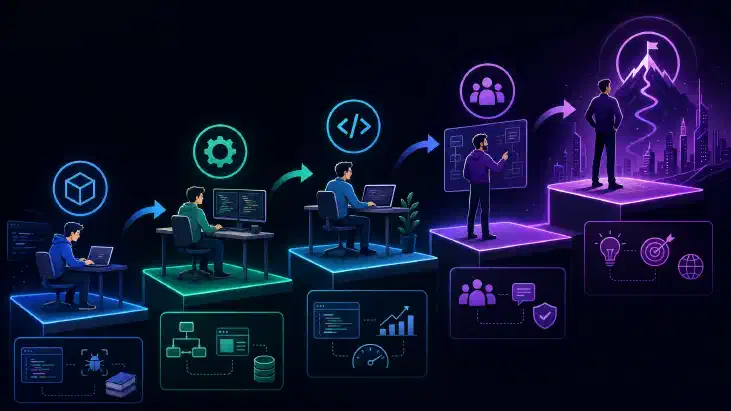
Table of Contents
Click Here to Return To the Software Development Career Playbook
The software developer career path is one of the clearest in professional work: each level is defined by the scope of problems you can independently solve and the quality of judgment you demonstrate. You move up by taking on more complex work, shipping more reliably, mentoring others, and expanding your technical and business context. Titles and timelines vary by company, but the underlying progression is consistent.
The Standard Career Ladder
| Level | Title Range | Typical Timeframe | Scope |
|---|---|---|---|
| L1 | Junior Developer, Software Engineer I | 0–2 years | Assigned tasks, learns codebase, works under close supervision |
| L2 | Developer, Software Engineer II | 2–4 years | Owns features independently, reviews others’ code, minimal supervision |
| L3 | Senior Developer, Senior Software Engineer | 4–8 years | Designs systems for a team, mentors juniors, leads technical decisions |
| L4 | Staff Engineer | 7–12 years | Technical leadership across multiple teams or a business domain |
| L5 | Principal Engineer | 10+ years | Company-wide technical strategy and architecture |
| L6 | Distinguished Engineer / Fellow | 15+ years | Industry-defining technical leadership; very few reach this level |
At L3 (Senior), most companies also offer a branch onto the management track: team lead and engineering manager.
Junior Developer (L1)
A junior developer is actively learning the codebase, tools, and team norms. They deliver assigned tasks with guidance, write code that functions but may need refinement in style or edge case handling, and ask questions frequently.
What drives promotion from junior:
- Completing tasks without repeated back-and-forth for clarification.
- Writing code others can read and modify.
- Learning to debug independently before escalating.
Typical timeline from junior to mid-level: 12 to 24 months at most companies.
Mid-Level Developer (L2)
A mid-level developer owns features end-to-end. They understand the codebase well enough to navigate it without guidance, can estimate their own work reliably, and contribute to technical discussions.
What drives promotion from mid-level:
- Taking ownership of features with no specification gaps or hand-holding.
- Beginning to review others’ pull requests with useful feedback.
- Identifying and fixing problems proactively, not just responding to tickets.
Senior Developer (L3)
This is the level most engineers spend the longest period of their career. A senior developer designs systems, not just features. They evaluate trade-offs, make architectural decisions within their team’s domain, and actively level up more junior engineers.
What drives promotion from senior:
- Demonstrable impact beyond your own code: the team ships better because you are on it.
- Leading technical projects from scoping through delivery.
- Communicating technical decisions clearly to non-engineers when required.
Senior Developer is the terminal level at many companies and a well-compensated, sustainable long-term role. Not everyone needs to go above it.
Staff Engineer (L4)
A staff engineer’s scope extends beyond a single team. They work on problems that affect multiple teams, identify cross-cutting technical risks, define standards, and guide multiple engineers’ technical growth.
Staff engineering is a specialist path, not a mandatory one. It requires a level of systems thinking and organizational navigation that not every senior engineer develops or wants to develop.
Engineering Manager (Branch from L3+)
An engineering manager is responsible for the people on the team, not the technical output directly. The EM hires, runs 1:1s, handles performance reviews, removes blockers, and aligns team work with business priorities.
The IC-to-EM decision is one of the most significant a software developer faces. See Software Engineering Technical Tracks and Engineering Management Career Path for a detailed comparison.
Accelerating Your Progression
Three factors compress the timeline between levels:
- Taking on harder problems before you feel fully ready. Comfort zone work does not produce promotions.
- Making your work visible. Write design docs, present at team demos, share learnings in team channels.
- Mentoring others. The fastest signal of senior-level thinking is the ability to make someone else more effective.
Next Steps
- Advancing from Junior to Senior Developer
- Software Engineering Technical Tracks
- Software Development Career Playbook Home